About me

Showing posts with label primary school. Show all posts

Saturday, 1 March 2014

Aesthetics of the learning environment - the value of calmness

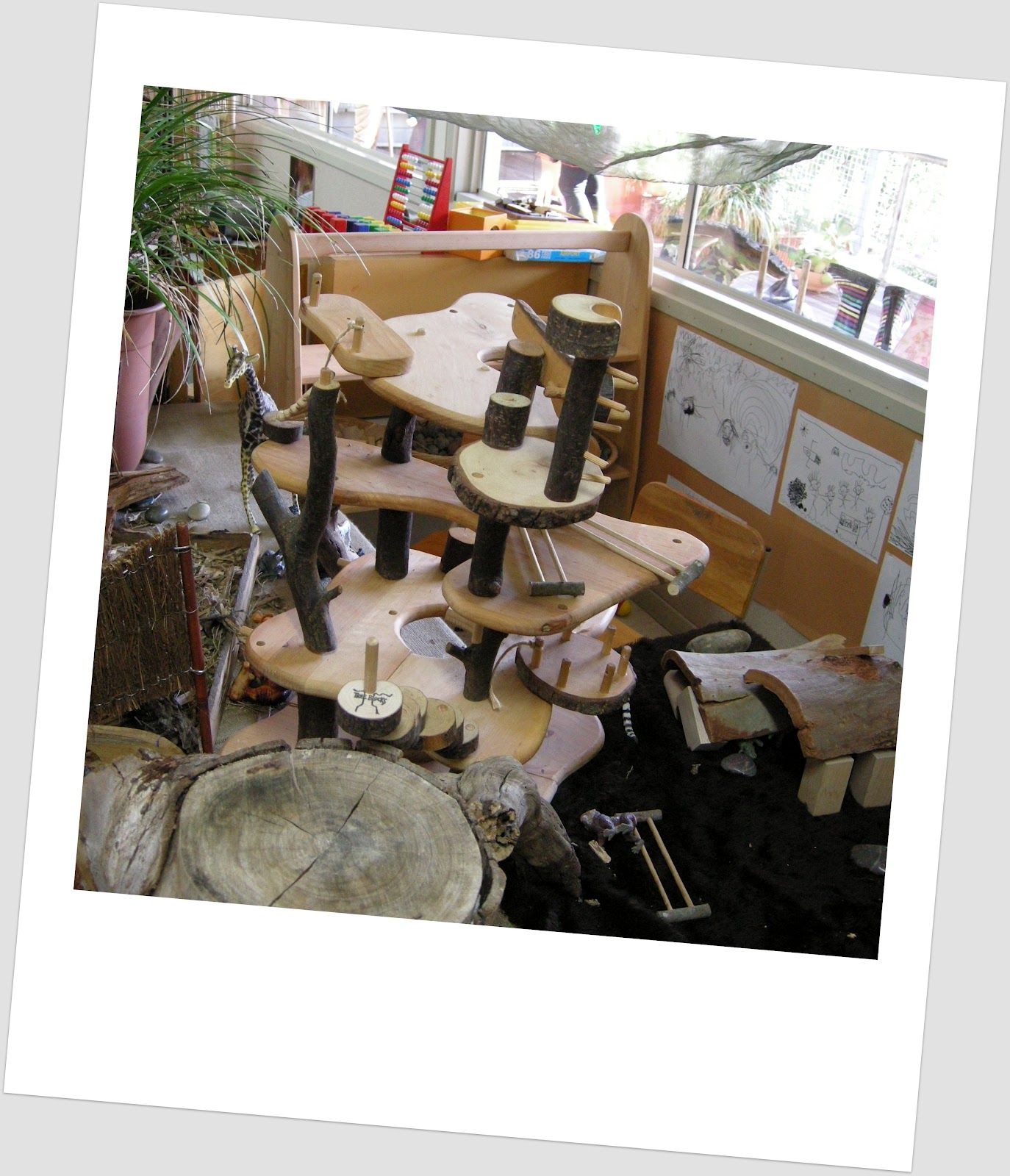
In many Reggio Emillia inspired centres that I have visited the value of calmness is very apparent in their environment, thus creating a calm space for children to interact with.

Decisions from the colour of furniture, to wall coverings, to what is put on the wall and display tables often reflect this value of calmness.  

One school I worked at had neutral colours and wall coverings. The overall effect was calming but it also ensured that the children’s work was not competing with bright colour backgrounds and boards.

Another school I worked at encouraged teachers to think very carefully about what they were displaying, how and why they were displaying it. Creating a soothing calm learning environment was a high priority.

When I first started teaching, 11 years ago, one of my favourite tasks was creating wall displays. Layer upon layer of colour, boarders and children’s work all competed for audience attention. Looking back I cringe at the visual chaos that was going on in my classroom. I hope that now I am a lot more thoughtful about  the aesthetics and visual impact my environment has.


Here are some inspiring pictures of calming environments; 


Tuesday, 14 August 2012

Materials available in the classroom

What choices are we making and why? The materials that we choose to have available to the children reflect our image of the child. If we believe children are capable, what resources are we providing them with?

In my classroom the children have access to a variety of materials such as clay, wire, recycled materials, and a variety of other open ended resources for them to express their ideas with.

I have a strong sense of sustainability and recycling, so there are many different types of materials that are collected and available to the children.


Children are given time to explore many different types of materials in order that they will become familiar with the characteristics and properties of these materials. The children are then able to select the materials they want to use to represent their ideas.

Thursday, 9 August 2012

What is a project? Curriculum perspective


Where is the project coming from? Is it something that the children have shown an interest in? Is it a requirement?

Why do you think this is an important project for the children?

A project encompasses core values, key competencies, habits of mind, building learning power skills etc A project's underlying objectives is to teach the children how to learn.

A project may challenge you as a teacher to let go of your pre-conceived ideas about where a project should be heading. Sometimes you have to let go of initial ideas that you had about a project.

My projects are not planned out from the beginning to the end. My project planning is a living document.

Some projects I have not known what the main curriculum focus would be because in the initial sates of the project I was still gathering information about the children's ideas and theories. One particular project that was sparked by the children's interest in butterflies could have a been a Science - living world project, however I discovered that most of the children already had a good understanding of the life cycle of a butterfly. My curriculum focus then became a Technology focus, with a minor focus on the life cycle.

Other projects like one that was sparked by our school show, had a clear arts focus from the start. However it did have a minor focus on social studies and geography as the children showed an interest in countries from around the world, maps, and atlases.

Being open to the possibilities is key for me - letting go of 'this is the way we have always done it'. I don't keep any unit plans from previous projects because each project is unique to the group of children I am working with at a particular point in time. There is documentation of the project (something I will talk about later) but I have moved away from replicating the same learning experiences year in and out.

Another big change inspired by this philosophy, has been not to teach themes for example it is autumn so we are all going to learn about autumn. I do still embrace these sorts of 'world around us' topics but the way the topics emerge is so different each year.

"Each individual can thus not only learn how to learn, but also become aware of the value of learning as a quality of life itself, in order to organise and multiply the learning opportunities as well as enjoy them and find pleasure in learning together with others." Carla Rinaldi


Monday, 6 August 2012

What is a provocation?

In the Reggio Emilia approach to teaching and learning the educators talk about provocations.

What is a provocation?

Provocations can come from the teachers, children or external sources such as the community. It is something that sparks questions, interest, ideas, theories, discussion, debate and engages the children's thinking.

Provocations could be:
  •  A concept i.e. change
  • A problem i.e. children touching chrysalises and damaging them
  • An object i.e. a map
  • Nature e.g. children's fascination with sticks
  • A question from the teacher
  • Questions from the children
  • Song lyrics
  • An event
  • A book
  • An interest that a child or group of children have
  • A requirement i.e. the school show


Wednesday, 1 August 2012

Classroom displays - the learning journey

A few years ago I decided that it was important to show how the teaching and learning in my classroom integrated many different curriculum areas. This meant moving away from having designated maths, writing and reading areas framed with different borders. This was a big change for me because I had traditionally always had a wall for writing, a wall for maths, a wall for reading and a wall for art.

How is the learning journey displayed in your classroom?


Displays are a powerful thing. I recently attended a lecture by Guy Claxton, where he challenged the audience to think about what we were displaying in our classroom. He spoke about displaying authentic work that demonstrates the learning process for example draft writing. Guy Claxton believes it is important for children to see what good learners do and that mistakes are a normal part of learning.

Monday, 30 July 2012

What is a project?

A project can be initiated by the teachers or the children
A project may start from 'requirements' i.e. everybody is studying the Olympics
A project may start with the seed of an idea or provocation

A project may involve just a group of children or the whole class
A project may be connected to other things
A project may start and be heading in a certain direction and then go off on other tangents
Sometimes you may not know where a project is going - this a good thing!

A project will have a big idea or concept behind it
A project caters for different levels and abilities
A project should spark more questions, more inquiry, more research
A project evolves and grows
A project will be open ended


Wednesday, 25 July 2012

Where to start? Tinkering and Tweaking

The way I began tinkering and tweaking my practice to align more with the Reggio Emilia approach to teaching and learning, was to look at our inquiry topic for the term.

Is there another way?

An example of how I thought about our inquiry topic:

Our team had chosen "space - planet earth and beyond" for all the classes to study for the term. I decided that instead of presenting the children with the topic of "space", I would go from a concept base. The concept I thought would work well was 'change' and from there I presented the children with the question "What changes can we see around us?"

The children came up with many ideas such as losing baby teeth (they were 5 and 6 years old). They also noticed the seasonal change outside - it was autumn. They also noticed the change of day and night. Over the term we explored these three aspects of change. I met all of the curriculum requirements just like every other teacher in the team, however my investigations were child led, concept based, thought provoking, based on the childern's interests and were my first tentative steps in embracing the Reggio Emilia approach to teaching and learning.


Monday, 23 July 2012

Aesthetics of the Learning Environment

In Reggio Emilia the environment is seen as the third teacher. My interpretation of this is to look at how spaces can be organised to inspire and engage children in learning. How am I setting up learning experiences for the children? How are materials or resources organised? What is available and accessible for the children? What do we value as a learning community and how is this portrayed in our space? I believe it is important to purposefully design the learning environment.


One of the first ways I changed the organisation of materials in my class was to organise my art materials by colour. I sorted all of the coloured pencils and felt pens into containers based on their colour. It makes accessing the materials easier for the children, as does keeping it tidy, but it also inspires them to see all of the shades of red or yellow. This way of organising art materials also enables the children to carefully think about what colours they want to use in their work.

Wednesday, 18 July 2012

What is Reggio Emilia? Part 2

The Reggio Emilia approach to teaching and learning is interpreted by teachers in their own contex, working within the framework of their culture, values, environment and National curriculum.

Becaues this approach is interpreted within a framework, there are no templates or formula. This is the challenge for us as teachers because we are not waiting for someone else to figure it out and tell us what to do. The challenge is for us to interpretate this philosophy. There is no destination that you will arrive at that says "You are now Reggio". This is a journey. I am challenged on a daily basis as I am inspired to align my knowledge of the principles of Reggio Emilia with my classroom practice.

Monday, 16 July 2012

What is Reggio Emilia? Part 1

The Reggio Emilia approach to teaching and learning is an educational philosophy founded in the Italian province of Reggio Emilia. Reggio Emilia is not a pre-set curriculum, rather it is a process of inviting and sustaining learning; it is a philosophical approach to working with children. The key principles of this approach are:

  • The image of the child
  • The image of the teacher
  • The pedagogy of relationships
  • The learning environment
  • The pedagogy of documentation - making learning visible
  • Provocations, investigations and projects